
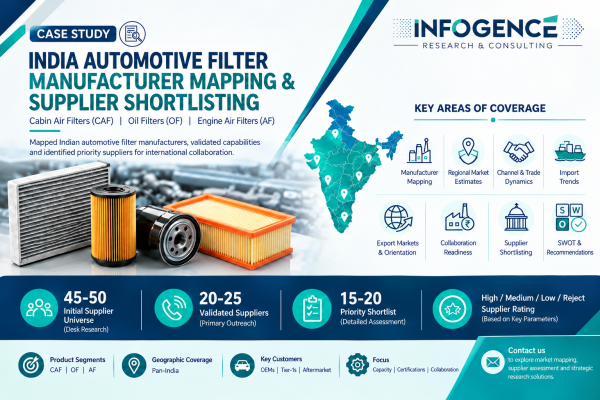
Client Brief
An International Automotive Components Company partnered with Infogence to conduct Automotive Filter Manufacturer Mapping across India, covering Cabin Air Filters (CAF), Engine Oil Filters (OF) and Engine Air Filters (AF). The study aimed to validate the supplier landscape, assess manufacturing and quality capabilities, and identify potential partners for international collaboration.
Market Overview
India’s Automotive Filter Industry serves OEMs, Tier-1 suppliers and the aftermarket. Manufacturers differ in product portfolios, production capabilities, quality certifications and export presence. This landscape creates opportunities for international companies seeking suitable suppliers for joint production, contract manufacturing and product development.
Key Questions Addressed
Infogence addressed the following business questions:
- Supplier Landscape: Who are the active Indian manufacturers across CAF, OF and AF categories?
- Manufacturing Capability: What products, production capacities and utilization levels do suppliers report?
- Quality Assessment: Which quality certifications and manufacturing systems do suppliers maintain?
- Customer Profile: Do manufacturers serve OEMs, Tier-1 suppliers or aftermarket customers?
- Export Presence: Which suppliers have international market experience?
- Collaboration Potential: Which manufacturers demonstrate interest in international partnerships?
Research Methodology
Infogence combined desk research with structured phone and email outreach to assess approximately 45–50 Indian Automotive Filter Manufacturers. The study validated product portfolios, manufacturing locations, production capacity, certifications, customer segments, export presence and collaboration interest. The screening process narrowed the initial universe to 20–25 validated manufacturers, followed by a priority shortlist of 15–20 suppliers. The assessment recorded confirmed information, while non-disclosed details were marked accordingly.
Strategic Recommendations
Infogence prioritized suppliers based on product fit, manufacturing capacity, quality certifications and collaboration readiness. The study recommended focused engagement with suitable manufacturers for joint production, contract manufacturing, co-development and joint ventures. It also identified relevant business development and plant-level contacts for further technical and commercial discussions.
Conclusion
The study transformed an initial universe of approximately 45–50 manufacturers into a priority shortlist of 15–20 suppliers. The findings provided structured intelligence on manufacturing capabilities, quality systems, customer segments and partnership potential, supporting informed supplier engagement and subsequent due diligence.
Looking to identify reliable manufacturing partners and expand your supplier network? Contact Us! for comprehensive market research, supplier mapping and actionable business insights.